

📖 Chapter 2 — Comparing Fabrics: How to Choose the Right Material?
When you walk into a fabric shop, two materials can sometimes look very similar.
They may have a similar colour, a pleasant feel, and even appear almost identical at first glance.
Yet once they are cut, sewn, and worn, they can behave in completely different ways.
This is particularly important in sewing.
A material that is perfectly suited to a summer dress will not necessarily be suitable for a wedding dress. A fabric that creates beautiful volume may not provide the fluidity needed for another design.
And some comparisons can even be confusing: silk and satin, for example, do not actually refer to the same thing.
In this second chapter of L’Atelier des Matières, I invite you to compare several materials that we very often encounter in sewing.
Not to decide which one is “the best,” but to understand their differences and, above all, to know when and why to choose them.
Article 1
🌿 1 — Cotton or Viscose: What’s the Difference?
Cotton and viscose are very often used to make lightweight and comfortable garments.
However, their origins and the way they behave are different.
Cotton
Cotton is a natural plant fibre obtained from the cotton plant.
Depending on its quality and whether it is woven or knitted, it can be used to create extremely different textiles: poplin, cotton voile, double gauze, denim, cotton satin…
That is precisely why simply saying “it’s cotton” is not enough to know how a fabric will behave.
In sewing, I particularly appreciate cotton when a design calls for a material that is comfortable to wear, relatively stable, and easy to work with.
But everything depends on the type of cotton chosen.
Cotton voile and denim are both made from cotton, yet they obviously do not have the same weight, drape, or uses.

Viscose
Viscose is different.
It is made from natural cellulose, most commonly derived from wood, which is processed and then regenerated into textile fibres.
However, wood is not the only possible source. The cellulose used to make viscose can also come from cotton, particularly from cotton linters — the very short fibres that remain around the seed after the main cotton fibres have been harvested.
This is an interesting detail, because cotton and viscose are often presented as two completely separate materials, even though the cellulose used to produce some viscose fibres can itself come from cotton.
Viscose is nevertheless classified as a manufactured cellulosic fibre, because the natural cellulose undergoes a transformation to become a new textile fibre.
In clothing, viscose is often appreciated for its fluidity, softness, and movement.
It can be an excellent choice for a dress, skirt, blouse, or flowing trousers.
But this fluidity also changes the way it needs to be handled.
A very fluid viscose fabric can shift more during cutting and may require greater precision when sewing than a stable cotton fabric.
So, Cotton or Viscose?
It all depends on the result you want to achieve.
For a design that requires more stability and structure, certain cotton fabrics can be particularly suitable.
For a garment with plenty of movement and fluidity, viscose can be beautiful.
So I don’t just look at the fibre composition: I look at what the fabric will bring to the garment.

Article 2
🌾 2 — Linen or Cotton: Which One Should You Choose?
Linen and cotton are both natural plant fibres.
They are often associated with summer clothing, but they produce very different results.
Linen
Linen has a very distinctive character.
It can feel slightly crisp to the touch and sometimes have a naturally irregular appearance. It also wrinkles quite easily.
But these characteristics are not necessarily flaws.
They are part of its identity.
With its natural appearance and beautiful behaviour when carefully chosen, linen can give a garment a great deal of character.
It is particularly appreciated for dresses, shirts, trousers, lightweight jackets, and summer clothing.

Cotton
Cotton can have a more even appearance and, depending on the fabric chosen, can be easier to handle when sewing.
But once again, there are so many different types of cotton fabric that it is important to avoid generalisations.
A lightweight cotton may be suitable for a blouse or a summer dress, while a more structured cotton can be used for a jacket or a skirt that requires more body and structure.
Linen or Cotton?
I would not choose simply between two names written on a label.
I would first look at the design.
Am I looking for a natural, lively appearance? A very stable fabric? A certain amount of softness and flexibility? More structure?
There are also linen-cotton blends, which make it possible to combine some of the properties of both fibres.

Article 3
✨ 3 — Silk or Satin: They Are Not the Same Thing!
This is probably one of the most common misconceptions when talking about fabrics.
We often hear:
“Is this dress made of satin or silk?”
However, these two words do not refer to the same thing.
Silk Is a Fibre
Silk is a natural fibre of animal origin.
It can be used to create different types of fabrics with very different appearances.
So, not all silk fabrics are shiny, and not all of them look like satin.

Satin Is a Textile Construction
Satin refers primarily to a type of weave, meaning a particular way in which the threads are interlaced.
This construction generally creates a smooth, shiny surface on the right side of the fabric.
Satin can therefore be made from different fibres.
There can be silk satin, but also polyester satin or cotton satin.
This is why simply asking, “Is it satin?” does not tell you what the fabric is made of.
And for a Wedding Dress?
This is particularly important.
Depending on the fibre, weight, and construction of the satin, the result can be very different: very fluid, soft, heavy, or, on the contrary, much more structured.
For a wedding dress, I therefore pay close attention to both the fibre composition and the drape and structure of the satin.
Article 4
☁️ 4 — Organza or Chiffon: Which Fabric Should You Choose?
They can both be lightweight and transparent, but they behave in almost opposite ways.
Organza
Organza is fine and transparent, but it generally has a certain stiffness.
It is precisely this structure that makes it so interesting.
It can be used to create volume without necessarily adding much weight.
In dressmaking, it can be used to create volume in certain dresses, as well as for sleeves, layers, or decorative details.

Chiffon
Chiffon is also fine and transparent, but its main appeal lies in its lightness and fluidity.
It moves beautifully with the body.
It can be particularly beautiful for creating airy skirts, lightweight sleeves, or different layers.
However, because it is fine and tends to shift easily, it requires greater care and precision when cutting and sewing.
Organza or Chiffon?
I ask one very simple question:
Do I want to create volume or movement?
If I am looking for structure and volume, I would be more likely to choose organza.
If I am looking for an airy, flowing effect, chiffon will often be the more suitable choice.
Article 5
👰 5 — Soft Tulle or Stiff Tulle: What Are the Differences?
Tulle is an essential fabric in the world of bridal wear.
But not all tulles are the same.
Soft Tulle
A very soft tulle naturally follows the movement of the body.
It can be used for certain veils, layered skirts, sleeves, or various delicate details.
Its main advantage is its ability to maintain a sense of lightness.
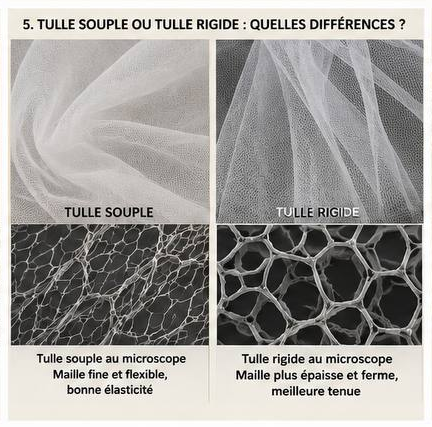
Stiff Tulle
A stiffer tulle has more body and structure.
It can be used when you want to support volume or add more fullness to a skirt.
In certain dress constructions, it can therefore play an important technical role.
Two Types of Tulle, Two Different Purposes
Choosing a tulle simply because it looks beautiful is not enough.
I touch it, handle it, and immediately observe how it reacts.
A tulle intended for a delicate veil does not need the same properties as a tulle used to create volume in a skirt.
Article 6
🪡 6 — Different Types of Lace: How to Recognise and Choose Them
Lace is a world of its own.
When we simply say “a lace dress,” we may actually be referring to very different materials.
Some laces are very fine and delicate.
Others are thicker, more graphic, or feature raised, textured patterns.
Some have a beautifully finished border that can be used along the hem of a dress, on a sleeve, or around a neckline.
There are many different families and techniques of lace, as well as numerous types of lace embroidered onto tulle.
But for me, when choosing lace for a creation, its name is not the only thing that matters.

I First Look at the Pattern
Is it small and delicate?
Large and dramatic?
Geometric?
Floral?
The design of the lace can completely change the overall look of a dress.
Then I Look at Its Texture
A very flat lace will not create the same effect as lace with raised motifs or appliqués.
On a wedding dress, these details can add a great deal of depth.
I Look at the Border
When a lace has a beautifully finished or scalloped edge, I immediately think about how I can incorporate it into the design.
This border can sometimes become a true design feature.
Above All, I Look at the Dress as a Whole
A spectacular lace is not automatically the best choice.
Sometimes, a very delicate lace enhances the cut of the dress more beautifully.
On the other hand, with an intentionally simple design, a more striking lace can become the main feature of the creation.
The lace should complement the design of the dress, not compete with it.
📌 Key Takeaways
✓ Cotton and viscose can both be comfortable to wear, but they behave differently.
✓ Linen and cotton are both natural fibres, but they do not have the same appearance or drape.
✓ Silk is a fibre, while satin refers to a type of weave.
✓ Organza generally provides more structure, while chiffon provides more fluidity.
✓ Soft tulle and stiff tulle do not serve the same purpose in a creation.
✓ Not all laces are the same: their pattern, texture, flexibility, and borders can completely change the final result.
✓ There is no single perfect fabric for every creation.
The right fabric is the one that allows you to achieve the result you are looking for.
✂️ Souad’s Advice — Maraval Couture
After more than 30 years of sewing, when I choose a fabric, I do not start by asking myself which one is “the best.”
I start by looking at the creation I want to make.
I take the fabric in my hands, look at its drape, move it around, and already imagine how it will look once it has been cut and sewn.
For a wedding dress, for example, just a few centimetres of difference in the structure or flexibility of a fabric can completely change the silhouette.
That is also why, whenever possible, I always recommend touching and handling fabrics before choosing them.
A photograph can show you a colour or a pattern.
An Experience from the Atelier
Wedding dresses are often associated with satin, lace, tulle, or silk. Yet among the creations I have made, two linen wedding dresses have particularly stayed with me.
For both designs, we chose washed linen. This fabric gave the dresses a natural, elegant look that was quite different from the materials usually seen in bridal wear.
The first bride wanted a dress fitted through the upper body and then flaring towards the hem. To add a special detail to this silhouette, we created embroidery all along the lower part of the dress, following the border: delicate stems with leaves and small floral motifs.
The result was both detailed and delicate, while still preserving the natural character of the linen.
The second bride chose something much more minimalist: a sleeveless dress with a low-cut back, fairly straight through the upper body and then slightly flared from the hips.
There were very few decorative details, but the washed linen, the cut, and the drape were enough to give the dress all its elegance.
These two creations were very different, yet they were made from the same material.
That is also what I love about my work: a fabric alone never determines the style of a dress. Everything depends on how we choose it, how we cut it, and what we decide to create with it.
Can you substitute one fabric for another when using a sewing pattern?
Yes, sometimes.
But not always.
If the replacement fabric has a very different drape, stretch, thickness, or structure, the finished garment may look completely different from the intended design.
Before replacing one fabric with another, it is therefore important to understand why the original fabric was chosen.
This is a very useful habit in sewing: do not simply look at the name of a fabric, but understand how it behaves.
📖 Read Next
➡️ Chapter 3 — Which Fabric Should You Choose?
After learning how to compare different materials, we will move on to an even more practical question:
Which fabric should you choose for the garment you want to make?
Summer dresses, wedding dresses, evening gowns, made-to-measure suits, clothing for hot weather, or fabrics for winter…
We will explore how to choose the right textile for each project.
🧵 Contact — Maraval Couture
📍 Maraval Couture8 rue Michel Rondet42000 Saint-Étienne, France
📞 +33 7 53 36 27 79
For any questions about fabrics, your sewing projects, made-to-measure creations, or sewing classes, please feel free to contact Maraval Couture.


Comments